
With escalating geopolitical tensions in the Middle East, and persistent concerns about rising energy prices and renewed inflationary pressures, the likelihood of US monetary policy remaining tighter than European monetary policy is increasing, which could support the US dollar in the coming period.
In this report, we examine the historical relationship between the yields of two-year US and German government bonds, the difference between them, and its impact on the US Dollar Index (DXY) from 2020 to the end of 2025, with the aim of estimating the potential levels of the index under different scenarios for widening yield spreads.
First: The historical relationship between yield spreads and the dollar index
Historical data for the period 2020–2025 showed a strong positive correlation between the yield spread of two-year US and German bonds and the US dollar index.
The wider the gap in favor of US bonds, the more attractive the dollar becomes, and vice versa.
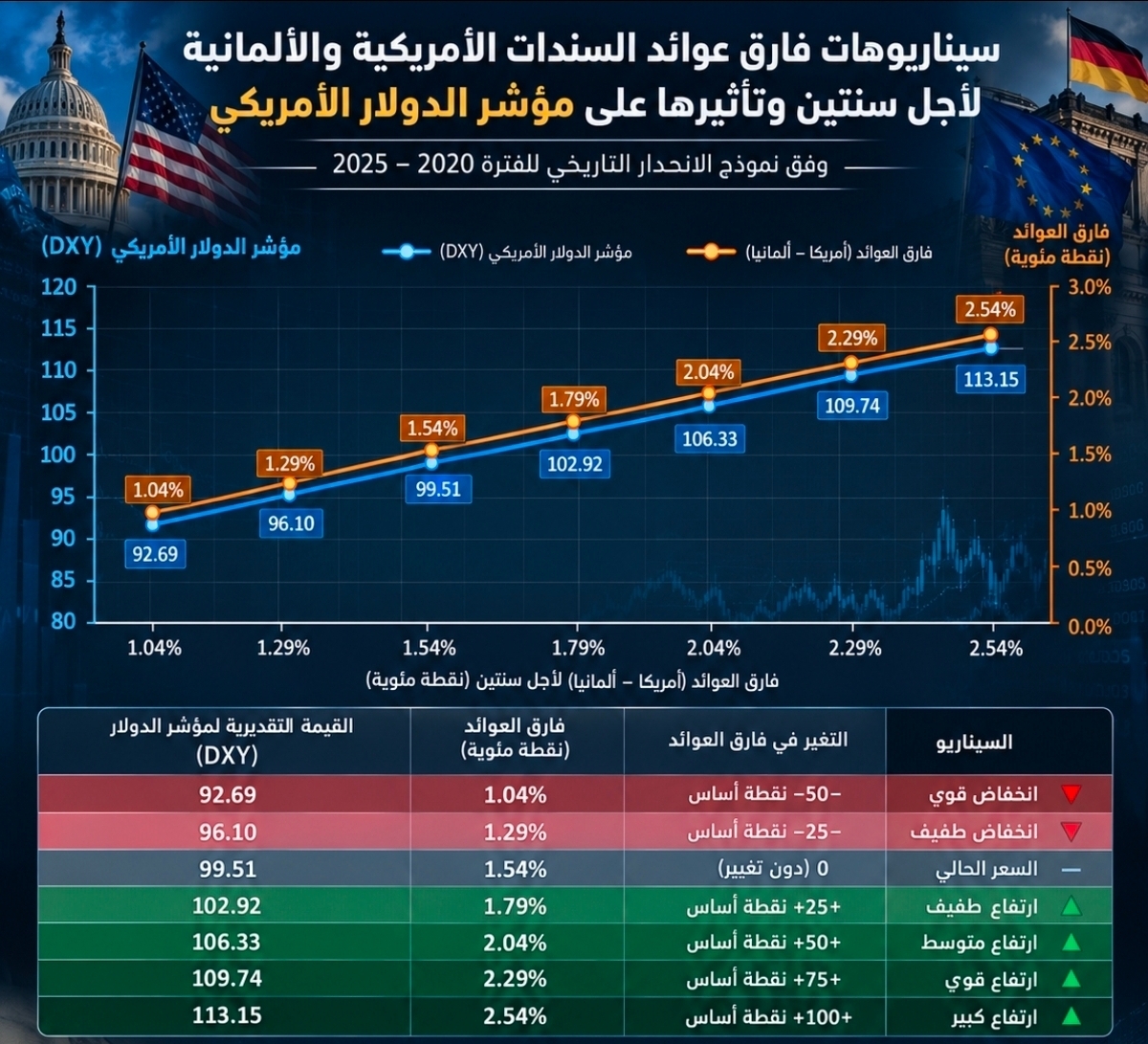
Based on the relationship between them, a 25 basis point increase in the spread corresponds to a theoretical increase of about 3.41 points in the index, while a 50 basis point increase in the spread leads to a theoretical increase of about 6.82 points.
Second: Scenarios for the US Dollar Index
If the gap widens in favor of the United States, we get the following scenarios:
The scenario: Yield spread/Theoretical Dollar Index down 50 basis points | 1.04% | 92.69
A decrease of 25 basis points | 1.29% | 96.10
No change | 1.54% | 99.51
Up 25 basis points | 1.79% | 102.92
Up 50 basis points | 2.04% | 106.33
Up 75 basis points | 2.29% | 109.74
Up 100 basis points | 2.54% | 113.15
A decrease of 25 basis points | 1.29% | 96.10
No change | 1.54% | 99.51
Up 25 basis points | 1.79% | 102.92
Up 50 basis points | 2.04% | 106.33
Up 75 basis points | 2.29% | 109.74
Up 100 basis points | 2.54% | 113.15
These scenarios show that a widening of the yield spread by 50 basis points, from 1.54% to 2.04%, raises the theoretical value of the dollar index to about 106.33 points.
If the gap widens by 75 basis points, the theoretical value could reach 109.74 points, while a widening scenario of 100 basis points indicates a level of 113.15 points.
Third: How can geopolitical tensions support the dollar?
Continued military escalation in the Middle East, coupled with rising oil and gas prices, could lead to renewed inflationary pressures on the global economy.
If these developments push the US Federal Reserve to adopt a tighter monetary policy compared to the European Central Bank, US bond yields may rise relatively, and the gap between them and German yields may widen.
This scenario would provide additional support for the US dollar.
However, rising energy prices do not necessarily mean a widening yield spread, as Europe could also face inflationary pressures that push German yields higher. Therefore, the direction of the spread depends on the response of both the Federal Reserve and the European Central Bank, and on market expectations regarding their actions.
Fourth: Conclusion and Expectations
Historically, the widening spread between two-year US and German bond yields is one of the key factors supporting the US dollar index.
Based on the model, a 50 basis point widening of the spread could raise the theoretical value of the index to around 106 points, while a 75 to 100 basis point widening would indicate theoretical levels ranging between 109.74 and 113.15 points.
Therefore, continued geopolitical tensions, coupled with a widening yield spread in favor of the United States, could create a supportive environment for a further rise in the US dollar.
However, the levels mentioned represent conditional statistical estimates and not definitive price targets, especially since the model does not directly include the impact of safe-haven flows, economic growth forecasts, or shifts in global risk appetite.
In summary: A 50 basis point widening of the US and German yield spread may be sufficient, according to the estimated historical relationship, to push the theoretical value of the US dollar index to 106.33 points, with the possibility of reaching higher levels if the spread continues to widen in favor of the United States.