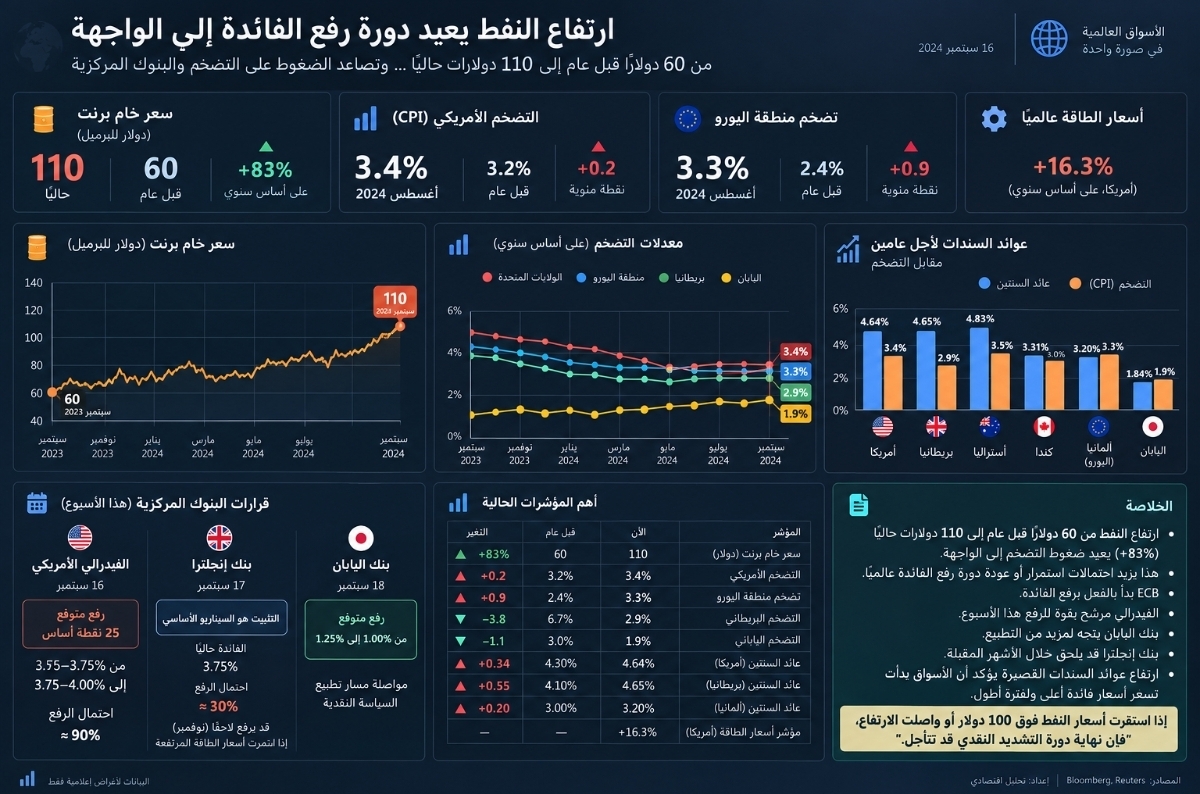
The continued rise in oil and energy prices is one of the most prominent factors bringing the risks of inflation and monetary tightening back to the forefront of the global economy. Brent crude has climbed to nearly $108 a barrel , while US crude has surpassed $102 , amid ongoing supply disruptions and escalating geopolitical risks in the Middle East.
The continued rise in oil prices above $100 does not only affect the energy sector, but gradually extends to transportation and production costs, supply chains, and prices of goods and services , increasing the likelihood of the energy shock spreading to overall inflation and then to core inflation and long-term inflation expectations.
The European Central Bank begins a tightening cycle.
The European Central Bank (ECB) has already begun moving in this direction, after raising interest rates on September 10 by 25 basis points , bringing the deposit rate to 2.50% .
This level appears relatively low compared to the eurozone's inflation of around 3.3% in August . Governing Council member Martin Cazac also stressed that the 2.5% level should not be considered a ceiling for interest rates.
Therefore, continued high energy prices may prompt the European Central Bank to continue tightening in the coming months, especially if the effects of rising oil prices begin to spread to the rest of the components of inflation.
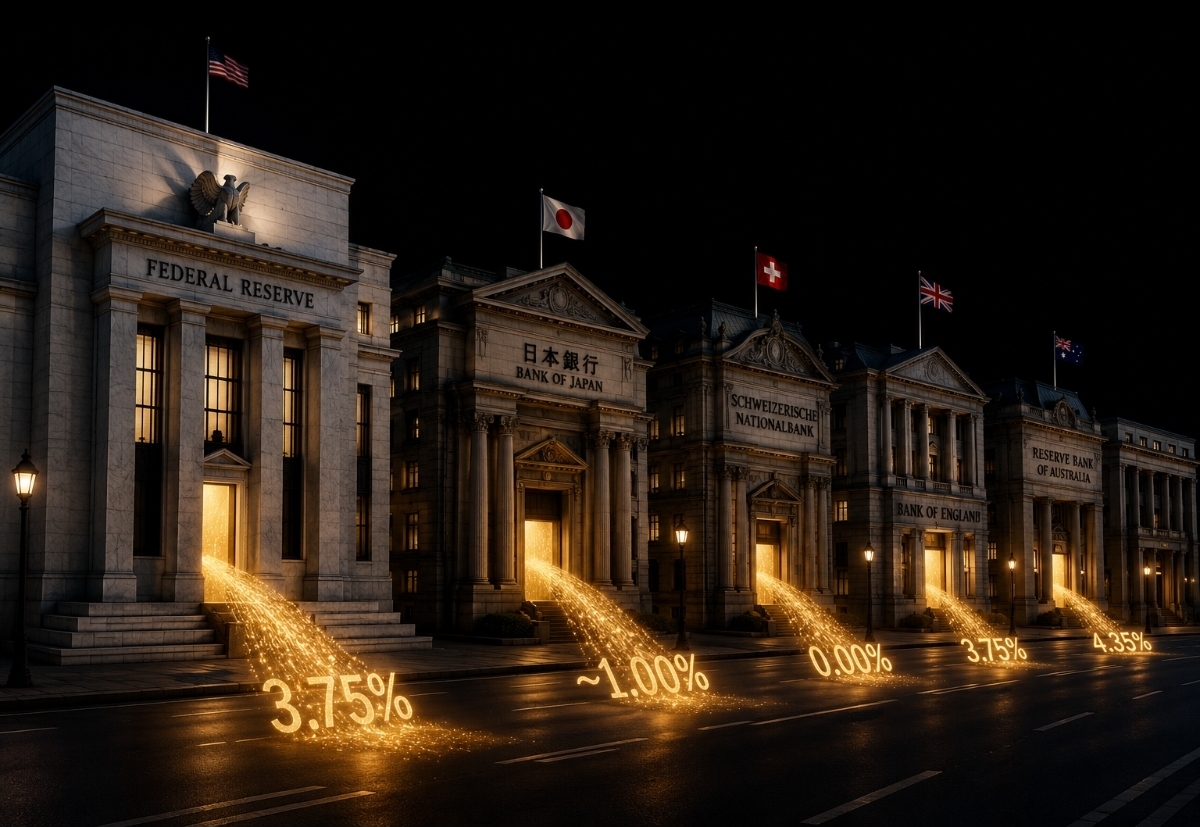
The Federal Reserve, the Bank of England, and the Bank of Japan this week
US Federal Reserve – September 16
The most likely scenario at present is a 25 basis point interest rate hike, from a range of 3.50–3.75% to 3.75–4.00% , with markets pricing in a probability of a hike of around 90% .
These projections come after US inflation reached 3.4% and energy prices rose by approximately 16.3% year-on-year , coinciding with a continued strong labor market. The surge in oil prices increases the risk of inflationary pressures shifting from a temporary shock to more sustained inflation, thus reinforcing the case for continued monetary tightening.
Bank of England – September 17
The UK interest rate currently stands at 3.75% , compared to overall inflation of 2.9% . The baseline scenario for the September meeting remains that interest rates will remain unchanged, with economists generally predicting no increase this month, while the market is pricing in a near 30% probability of a rate hike.
But continued high energy prices could change this picture in the coming months and increase the likelihood of an interest rate hike at a later meeting, possibly in November.
Bank of Japan – September 18
Market expectations are largely focused on the Bank of Japan raising interest rates from 1.00% to 1.25% . Japan's situation differs somewhat from that of the United States and Britain, as the bank is still on a long path to normalizing monetary policy after years of ultra-low interest rates, but rising inflation and energy costs provide additional support for continuing this course.
Thus, the trend initiated by the European Central Bank could turn into a synchronized tightening wave among major central banks in the coming months, especially if oil prices stabilize above $100 and the effects of energy continue to spill over into core inflation.
Two-year bond yields versus inflation
Two-year government bonds are of particular importance because they are one of the most sensitive parts of the yield curve to expectations of monetary policy and the path of interest rates.
Economy 2-Year Yield Headline Inflation Yield minus Inflation 🇺🇸 United States | 4.64% | 3.4% | +1.24%
🇬🇧 Britain | ≈4.65% | 2.9% | ≈+1.75%
🇦🇺 Australia | ≈4.83% | ≈3.5% | ≈+1.33%
🇨🇦 Canada | 3.31% | 3.0% | +0.31%
🇩🇪 Germany / Euro | ≈3.20% | 2.9% / 3.3% | ≈+0.30% / −0.10%
🇯🇵 Japan | ≈1.84% | ≈1.9% | ≈−0.06%
🇬🇧 Britain | ≈4.65% | 2.9% | ≈+1.75%
🇦🇺 Australia | ≈4.83% | ≈3.5% | ≈+1.33%
🇨🇦 Canada | 3.31% | 3.0% | +0.31%
🇩🇪 Germany / Euro | ≈3.20% | 2.9% / 3.3% | ≈+0.30% / −0.10%
🇯🇵 Japan | ≈1.84% | ≈1.9% | ≈−0.06%
The latest prices put the yield on two-year US Treasury bonds near 4.64% , compared with about 4.65% in Britain, 4.83% in Australia, 3.31% in Canada, and about 3.20% in Germany, versus 1.83–1.84% in Japan.
What does the bond market tell us?
Higher inflation expectations typically lead investors to demand higher nominal returns to compensate for the future decline in the purchasing power of money. This correlation becomes even more significant for short-term bonds, such as two-year maturities, as they are directly affected by expectations regarding the trajectory of official interest rates.
Therefore, the rise in returns over the past two years, coinciding with rising oil prices and inflation, can be summarized in the following series:
Higher oil prices → Higher inflation expectations → Higher bond yields → Higher interest rate expectations → Greater pressure on central banks to tighten.
However, this relationship is not entirely automatic. Central banks may tolerate a temporary shock to oil prices if they believe it will not be transmitted to wages and underlying inflation. The greater risk lies in oil prices remaining high for an extended period , as this increases the likelihood of the shock spreading to other sectors of the economy and entrenching inflation, at which point the need to raise interest rates becomes more pressing.
Summary
If oil prices stabilize above $100 a barrel or continue to rise, the scenario that prevailed months ago, based on the approaching end of the monetary tightening cycle, could fundamentally change.
The European Central Bank has already started raising interest rates, the US Federal Reserve is strongly expected to raise them this week, the Bank of Japan is moving towards further normalization, and the Bank of England may follow suit in the coming months if energy pressures continue.
Meanwhile, rising short-term government bond yields indicate that markets have already begun to reprice their expectations toward higher interest rates for a longer period .
Therefore, rising oil prices may be the factor that reopens the monetary tightening cycle globally after markets had been betting on its imminent end.