
Preliminary data for September on the US manufacturing sector indicates a significant acceleration in price pressures , at a time when the US economy is still maintaining good levels of production and growth, bringing inflation risks back to the forefront of the economic landscape.
Data released today showed that the industrial sector price index jumped to 77.9 points in September, compared to 71.1 points in August . A reading above 50 indicates continued price increases, while readings in the 70s and 80s range reflect a very strong pace of price growth.
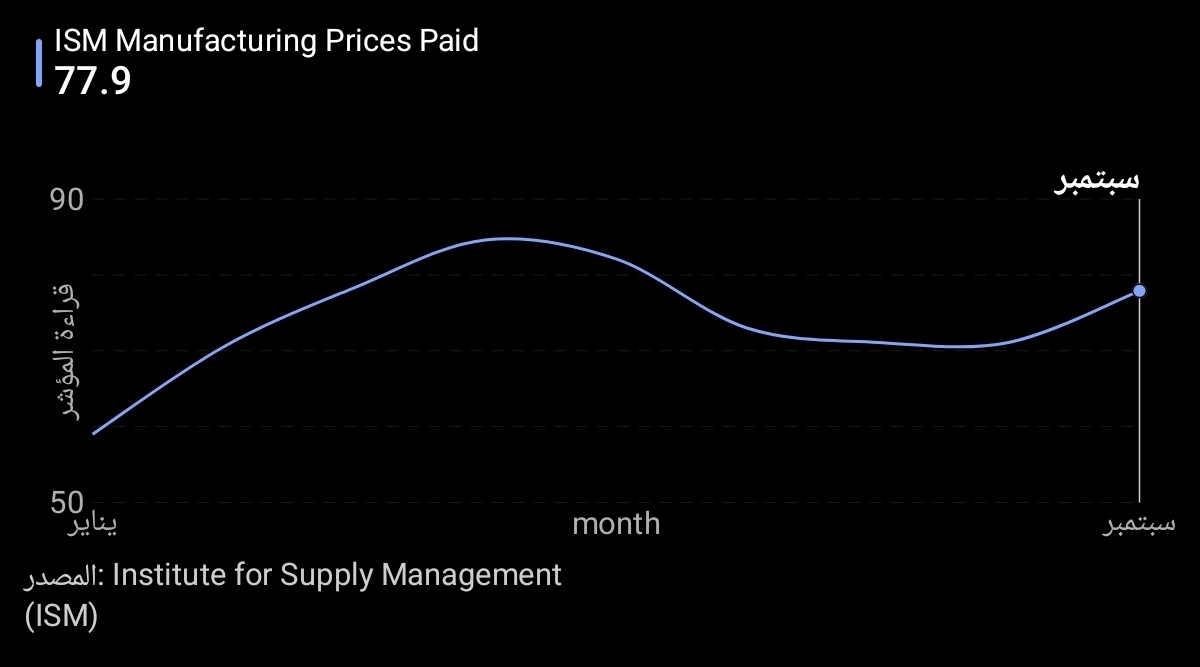
The key point in the chart: After the price pressures eased from the April peak, prices accelerated strongly again in September, with the index jumping from 71.1 to 77.9.
Similar pressures are expected to emerge in the services sector, especially after the rise in diesel, fuel and energy prices during September, with oil prices remaining above $100 a barrel, which raises transportation and production costs and increases the likelihood that some of these costs will be passed on to the prices of goods and services.
Inflation remains well above the Fed's target.
US inflation data, according to the Personal Consumption Expenditures (PCE) index, confirms that inflation remains above the levels targeted by the Federal Reserve.
The core reading on an annual basis through August indicates that prices rose by about 3% , compared to the Federal Reserve's target of around 2% . The quarterly reading of the core index through the end of the second quarter also showed an annual increase of about 3.3% .
Therefore, the monthly reading for August, which showed a limited increase of about 0.2% , becomes less important as September's data confirmed the return of accelerating price pressures.
The economy continues to grow despite inflation.
Ironically, rising prices have not yet been accompanied by a clear contraction in economic activity.
The Chicago Purchasing Managers Index (PMI) registered 58.8 points in September , while the ISM Manufacturing Index registered 54.5 points , close to the August reading, indicating continued growth in industrial activity.
The GDP data also confirms the continued expansion of the US economy, with the second quarter reading indicating growth of approximately 2.2% .
But price pressures also remained high, with the output price index for the second quarter, which includes a wider range of prices including the most volatile items, rising by about 6.1% .
The labor market remains stable
Despite rising energy costs, interest rates, and prices, there have been no signs yet of a sharp contraction in the labor market.
ADP private sector jobs data showed the addition of nearly 90,000 jobs during September , which means the economy is still able to create jobs despite inflationary pressures and tighter monetary policy.
Inflation is not just an American problem
The same image appears in varying degrees outside the United States.
In Australia, monthly inflation rose by about 0.4% during August, while annual inflation reached about 4% , remaining above the Reserve Bank of Australia's target range of between 2% and 3% .
These developments reinforce the likelihood of continued pressure on major central banks during the last quarter of the year, whether in the United States, Australia, or the Eurozone, with the option of raising interest rates again by a quarter of a percentage point remaining on the table if inflationary pressures persist.
Economic growth... but inflation is growing at a faster pace.
In conclusion, the economic picture does not yet indicate a clear economic contraction. Production is continuing, the economy is growing, and the labor market is still able to add jobs.
But the problem is that prices seem to be rising at an even faster pace .
The continuation of this situation poses a risk to growth in the coming period, because rising prices gradually erode consumer purchasing power, while high interest rates increase the cost of financing for households and businesses.
All eyes will be on the official US labor market data tomorrow, although its importance may be limited if it comes close to expectations.
The most important factor for the markets remains the developments in the US-Iran war , given its direct impact on global oil and energy prices, and consequently on the expected trajectory of inflation and monetary policy during the last quarter of the year.