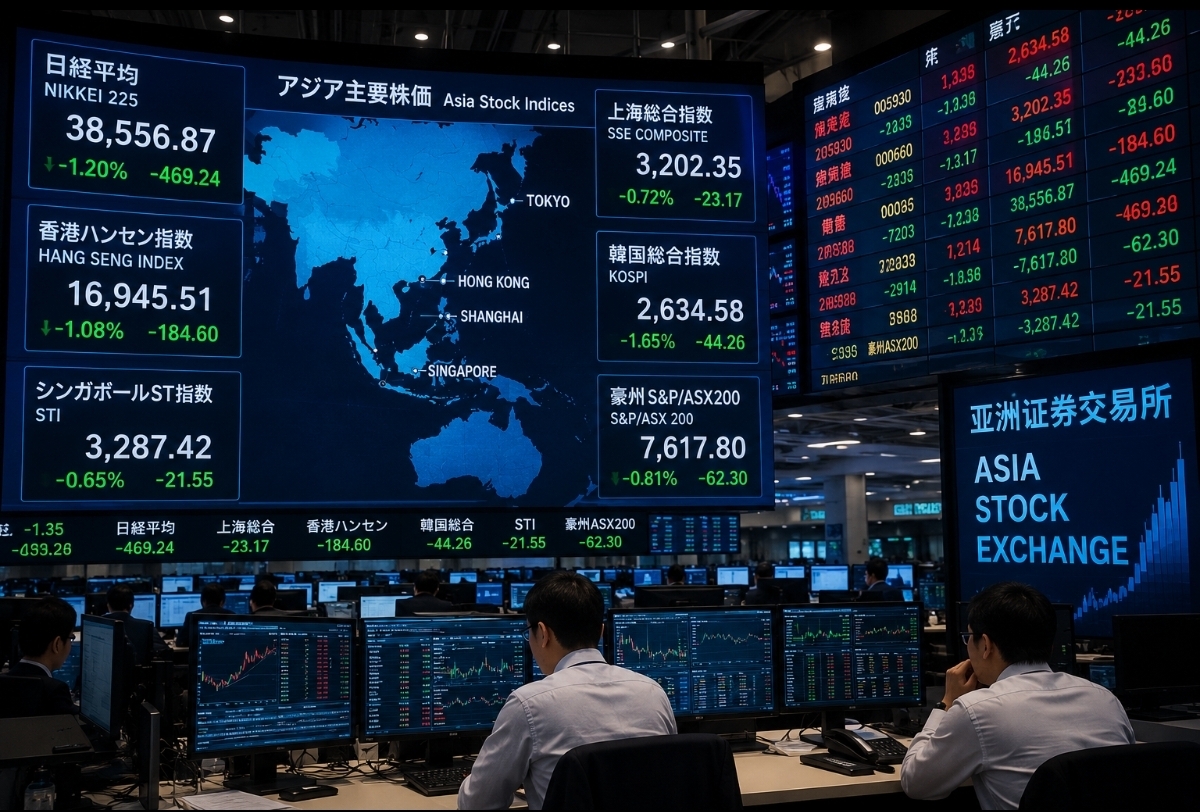
Global markets opened the week in a volatile and mixed manner, with European stock markets trading higher while US indices declined, coinciding with a slight rebound in oil prices. This comes as markets await developments in US-Iranian talks, amid continued uncertainty regarding the possibility of reaching an agreement and the future of the Strait of Hormuz.
The lack of a clear path for negotiations appears to remain the primary driver of investor sentiment. Over the weekend, US President Donald Trump rejected an Iranian proposal that included the possibility of reopening the Strait of Hormuz within seven days in exchange for a set of conditions, including easing military pressure and lifting the US embargo on Iranian ports. Despite rejecting the offer, Trump affirmed that talks would continue this week.
Diplomatic efforts are continuing today in New York through Qatari mediation , with separate talks involving Iranian Foreign Minister Abbas Araqchi and the American side, in an attempt to discuss a revised version of the Iranian proposal and to reach common ground on which to build for continued negotiations.
As of now, all scenarios remain open, with no clear path forward . There are no decisive indications that an agreement is imminent, yet negotiations have continued, which explains much of the volatile market activity.
Wall Street is declining, and technology is under greater pressure.
US stock indices are collectively declining during today's trading, with greater pressure on technology stocks.
The Dow Jones index is down 0.41% to 51,617.17 points , while the S&P 500 is down about 0.52% at 7,703.50 points .
Pressure is mounting in the technology sector, with the Nasdaq Composite falling 0.82% to 26,847.07 points and the Nasdaq 100 declining 1.17% to 30,249.71 points . The Russell 2000 is also down 0.72% at 2,817.04 points .
Europe is moving in the opposite direction
In contrast, European markets are showing more positive performance, reflecting the clear divergence between the two sides of the Atlantic.
The STOXX 600 rose 0.63% to 642.67 points , Germany's DAX climbed 0.48% to 25,530.54 points , while Britain's FTSE gained 0.51% to reach 10,749.74 points .
In France, the CAC rose by about 0.68% to 8,132.49 points , while Italy’s FTSE MIB climbed by 0.63% to 52,194.58 points .
Oil recovers some of its gains
In the energy markets, oil prices have rebounded amid continued uncertainty surrounding the negotiations and the future of shipping through the Strait of Hormuz.
US crude rose 1.50% to $93.80 a barrel , while Brent crude climbed 1.67% to $106.06 a barrel . In contrast, natural gas fell 3.54% to $3.083 .
This move indicates that markets are still holding onto a portion of the geopolitical risk premium , as the continuation of negotiations offers some hope for a possible de-escalation, but the absence of a clear agreement prevents concerns from subsiding completely.
Overview
The overall market outlook remains heavily dependent on the outcome of the US-Iranian talks in the coming days . So far, there is no definitive result, nor are there sufficient indicators to favor a scenario of de-escalation or escalation.
Therefore, the current volatility and heightened sensitivity to news and statements are likely to persist, especially given the direct link between the Iranian issue and energy markets and shipping traffic through the Strait of Hormuz. Any tangible progress in the negotiations could quickly translate into higher risk premiums, higher oil prices, and stronger stock market sentiment, while a breakdown in talks or a renewed escalation could trigger sharp price movements in the opposite direction.
In the absence of a decisive outcome, the same uncertainty remains the most prominent factor in the markets, making volatility likely to continue until a clearer path for negotiations emerges.