
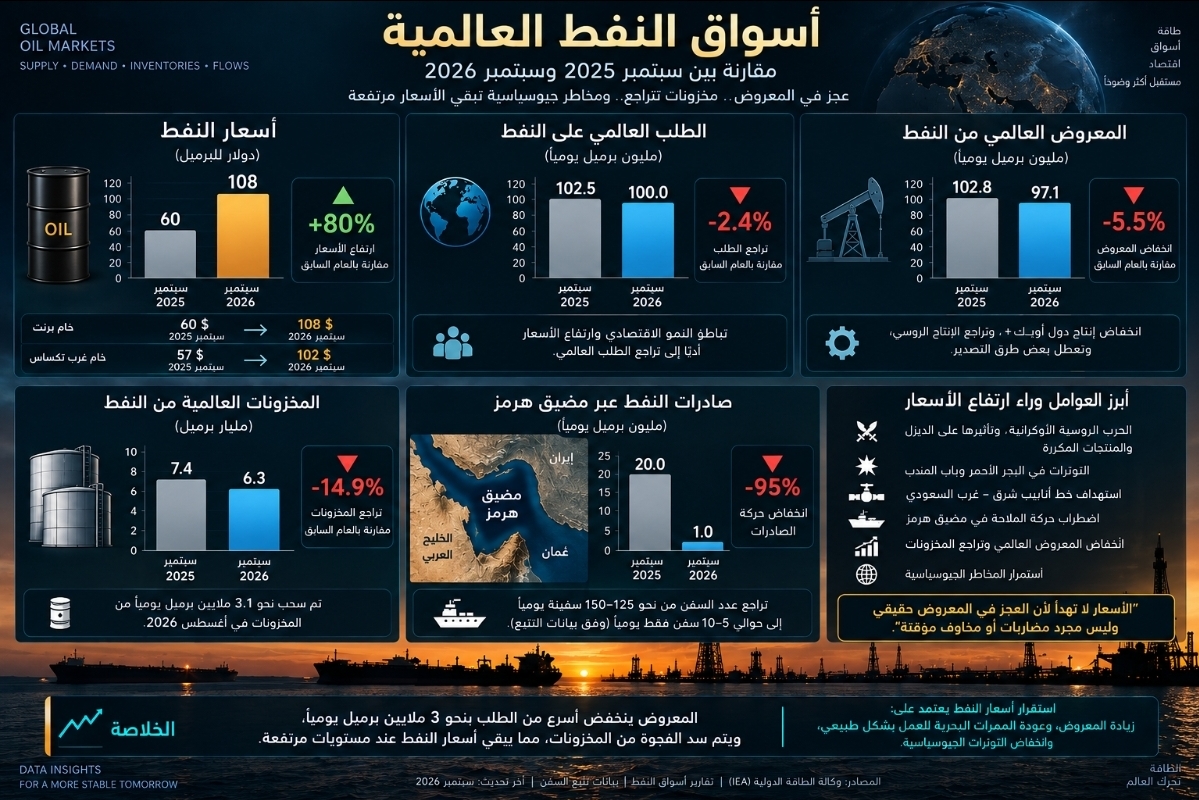
The global oil market is experiencing a deficit approaching three million barrels per day , which explains the continued high prices. The current surge is not solely driven by speculation or geopolitical concerns, but by a genuine gap between supply and demand, which is being bridged by drawing down inventories.
According to the International Energy Agency's September estimates, global supply is expected to decline by approximately 5.7 million barrels per day in 2026, compared to a drop in demand of about 2.5 million barrels per day, leaving a gap of roughly 3.2 million barrels per day . This has already been reflected in inventories, which fell by a record 3.1 million barrels per day in August, to levels not seen since 2023.
Gulf and Russian production declined
Global production fell in August by about 1.6 million barrels per day to approximately 100.1 million barrels, while OPEC+ production declined by about 1.8 million barrels. Saudi Arabia was among the hardest-hit producers, with its output dropping to around 6 million barrels per day .
This confirms that the problem is no longer limited to the difficulty of exporting Gulf oil, but has extended to production itself. When export routes are disrupted and quantities accumulate within facilities, the producers' ability to maintain full production becomes limited.
In Russia, the war with Ukraine added further pressure, particularly on diesel and refined products . Attacks on refineries and energy facilities disrupted some refining capacity, reduced fuel exports, and increased diesel refining margins.
Russian production fell in August to around 8.36 million barrels per day , while industry estimates indicate that refinery disruptions in Russia and the Middle East have removed significant quantities of refined products from the market. The problem is therefore twofold: a shortage of crude oil and an even more severe shortage of capacity to convert it into diesel, gasoline, and jet fuel.
Hormuz and Bab el-Mandeb are putting pressure on supplies.
The Strait of Hormuz remains one of the most dangerous elements of the crisis. Before the war, the strait saw about 125-150 crossings daily in both directions, while the traffic observed in recent days has decreased to levels estimated at about 5-10% of its normal levels .
It is true that some carriers may disable their AIS systems for security reasons, and therefore actual traffic may be higher than observed, but other indicators — from declining exports and production to falling inventories — confirm that there is a real disruption in supplies.
Meanwhile, a new front has emerged in the Bab el-Mandeb Strait with the escalation of the war in Yemen and the threats to shipping in the Red Sea. This strait is becoming increasingly important as it has become a key alternative route following the decline in traffic through the Strait of Hormuz.
If ships are forced to avoid Bab el-Mandeb and round the Cape of Good Hope , the journey could add up to 22 days in some cases, increasing fuel, insurance, and tanker costs and delaying shipments. Thus, even when barrels don't disappear from the market, their arrival becomes slower and more expensive, reducing effective supply .
Targeting the East-West line
Pressure increased after the Saudi East-West pipeline, which carries oil from the east of the kingdom to the port of Yanbu on the Red Sea, bypassing Hormuz, was targeted.
The pipeline had been carrying about 2.6–4 million barrels per day in recent weeks, but it was attacked and largely shut down, with repairs estimated to take three to five weeks .
The problem isn't limited to the repair time; the pipeline stretches for approximately 1,200 kilometers, making its complete protection from further attacks extremely difficult. This puts Saudi Arabia under pressure on its three most important export routes: the Strait of Hormuz, with very limited traffic; the damaged East-West pipeline; and the Red Sea, threatened by the escalating conflict around Bab el-Mandeb.
Why don't oil prices calm down?
Brent crude surpassed $107 a barrel and in some trading approached $109-$110, while US crude surpassed $102.
This reflects two concurrent factors. The first is the actual shortage resulting from declining Gulf and Russian production, refining disruptions, disruptions to some export routes, and significant drawdowns of inventories. The second is the added geopolitical risk associated with the potential for continued disruption in the Strait of Hormuz, escalating threats in the Bab el-Mandeb Strait, and renewed targeting of the East-West shipping lane, facilities, ports, and tankers.
Therefore, the fear premium is present in prices, but it comes on top of an existing financial deficit and is not a substitute for it.
Summary
The global oil market is facing a gap of nearly three million barrels per day as a result of supply falling at a faster pace than demand, and this is currently being compensated for by drawing down inventories.
Meanwhile, the Russian-Ukrainian war is putting pressure on refineries and diesel production, while disruptions to the Strait of Hormuz have led to a decline in Gulf exports and output. The war in Yemen adds new risks to the Bab el-Mandeb Strait, and attacks on the East-West shipping lane have weakened one of Saudi Arabia's most important alternatives to bypassing Hormuz.
Therefore, the current rise in oil prices is not just speculation or a psychological reaction, but rather the result of a combination of an actual deficit in barrels, a shortage of refined products, a rapid decline in inventories, and a bottleneck in the most important global oil export routes .
As long as supply continues to fall faster than demand, and inventories remain the primary means of bridging the gap, it is difficult for oil prices to stabilize sustainably, even if they experience temporary declines due to political news or attempts to de-escalate tensions.