Optimism prevailed in US and European stock markets today, with major indices rising across the board at the time of writing. Investors appear to have moved past the impact of the interest rate hike itself, focusing instead on the message conveyed by the Federal Reserve's projections regarding the US economy's ability to continue growing despite the tightening of monetary policy.
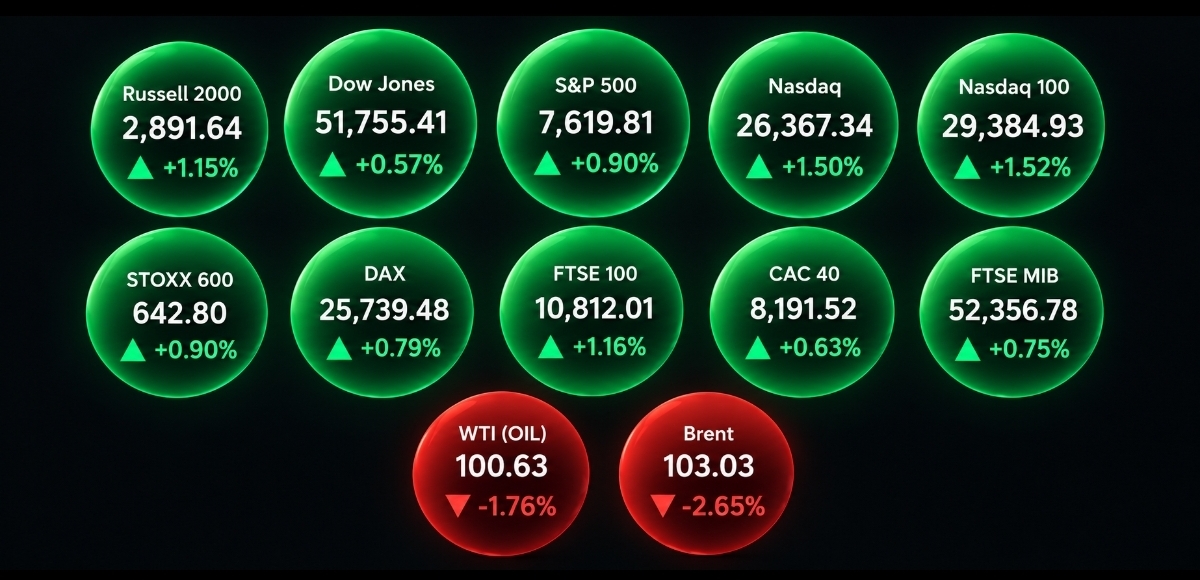
On Wall Street , the Dow Jones Industrial Average rose 0.57% to 51,755 points , and the S&P 500 climbed 0.90% to 7,620 points . Gains were strongest in technology stocks, with the Nasdaq up 1.50% to 26,367 points , the Nasdaq 100 up 1.52% to 29,385 points , and the Russell 2000 advancing 1.15% to 2,892 points .
In Europe , the picture was also positive. The STOXX 600 rose 0.90% to 642.8 points , the German DAX gained 0.79% to 25,739 points , and the UK's FTSE 100 climbed 1.16% to 10,812 points . France's CAC 40 also rose 0.63% to 8,192 points , and Italy's FTSE MIB advanced 0.75% to 52,357 points .
Why did stocks rise despite the interest rate hike?
It appears that the markets viewed the Federal Reserve's decision not only through the lens of the interest rate hike, but also in terms of the underlying economic picture . Continued healthy economic growth, relatively low unemployment, and expectations of gradual inflation control give investors greater confidence in the economy's and businesses' ability to withstand current interest rate levels.
In other words, the message received by the markets is that the interest rate hike is not currently a result of a breakdown in inflation control, nor does it coincide with a sharp economic downturn . If growth continues, the labor market remains resilient, and inflation gradually declines, this environment could remain supportive of corporate earnings and stock prices.
The decline in oil prices is supporting risk appetite.
Another positive factor came from the energy market. US crude fell 1.76% to $100.63 a barrel , while Brent crude dropped 2.65% to $103.03 .
The decline in oil prices, and the possibility of a short-term stabilization, are easing some of the inflationary pressures that have worried markets recently. As energy prices stabilize, pressure on transportation, production, and pricing costs decreases, which in turn reduces the need for further monetary tightening by central banks.
The Middle East remains the decisive factor
However, current optimism does not necessarily mean that markets have entered a sustained upward trend . The war in the Middle East is not yet over, and supply and energy price risks remain, so continued volatility is expected.
In the coming period, developments in the Middle East and oil prices will be among the most important factors determining the direction of global assets . If oil prices stabilize or decline, inflationary concerns may subside and investor risk appetite may improve. However, a sharp rise in oil prices due to geopolitical developments or new supply disruptions could quickly bring inflation and interest rate pressures back to the forefront.
Therefore, today's stock market rise does not necessarily mean a continuation of the upward trend, just as any upcoming downward wave does not necessarily mean a continuation of the downward trend . Markets are currently highly sensitive to events, and the direction of oil prices and developments in the Middle East will remain among the most important variables determining the movement of stocks, bonds, and currencies in the coming period.