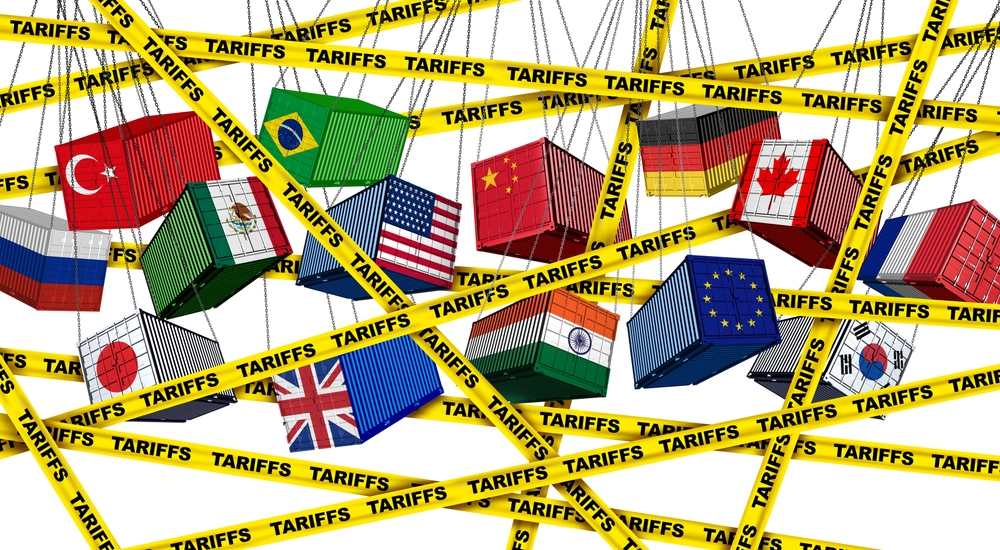
With the Trump-Xi summit approaching, the issue of tariffs is back in the spotlight. Data up to July 2026 shows that US protectionist policies have significantly reduced the trade deficit with China, but they have more than altered the deficit landscape.
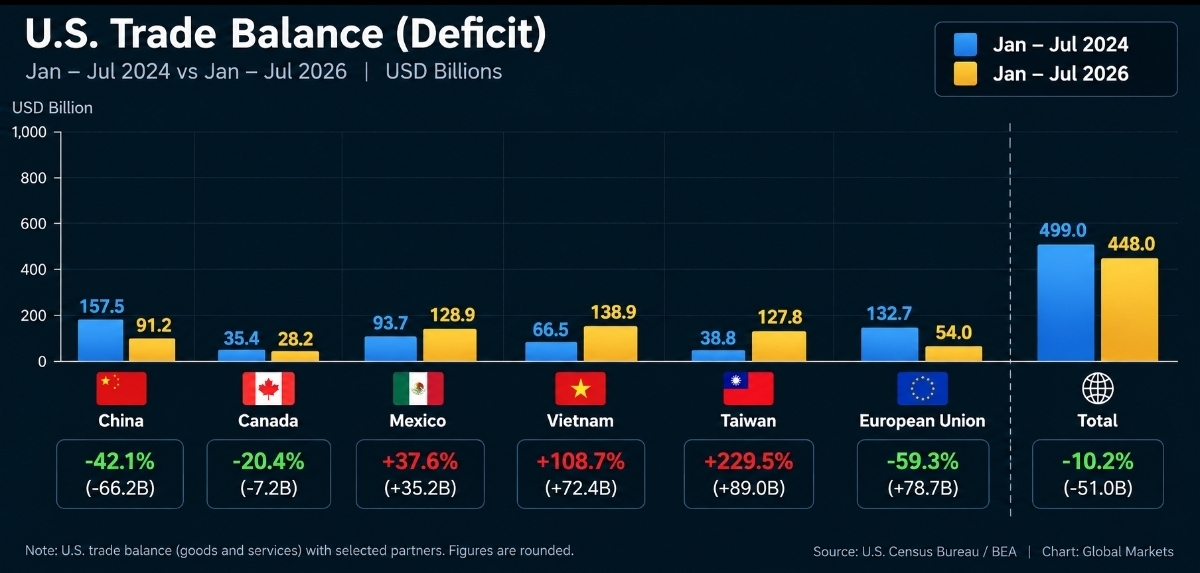
During January–July 2026, the total US deficit in goods and services was approximately $448 billion , compared to approximately $499 billion during the same period in 2024, a decrease of nearly 10% . Compared to the same period in 2025, the deficit decreased by approximately 29.6% .
The biggest shift was with China , where the goods deficit fell from $157.5 billion in 2024 to $91.2 billion in 2026 , a decrease of nearly 42% . The deficit also decreased with Canada and the European Union.
However, a large portion of the deficit was transferred to other partners:
Country/Region January–July 2024 January–July 2026 Change China | $157.5 billion | $91.2 billion | -42%
Canada | $35.4 billion | $28.2 billion | -20%
Mexico | $93.7 billion | $128.9 billion | +38%
Vietnam | $66.5 billion | $138.9 billion | +109%
Taiwan | $38.8 billion | $127.8 billion | +229%
European Union | $132.7 billion | $54.0 billion | -59%
Canada | $35.4 billion | $28.2 billion | -20%
Mexico | $93.7 billion | $128.9 billion | +38%
Vietnam | $66.5 billion | $138.9 billion | +109%
Taiwan | $38.8 billion | $127.8 billion | +229%
European Union | $132.7 billion | $54.0 billion | -59%
The sharp decline with China was accompanied by a widening deficit, particularly with Mexico, Vietnam, and Taiwan . This is due not only to the reorientation of supply chains, but also to a surge in imports of semiconductors, computers, and AI-related equipment.
Moreover, the improvement in the overall trade deficit is not entirely due to tariffs; the United States has a large surplus in services trade that offsets part of the goods deficit.
Summary
It can be argued that Trump's tariffs have clearly succeeded in reducing the direct deficit with China and have contributed to lowering the overall trade deficit compared to the past two years. However, they have not yet led to a similar decrease in the overall US goods deficit .
The most notable result is that the United States now imports less directly from China, but more from countries such as Vietnam, Taiwan, and Mexico .
In short: the tariffs changed the map of the US trade deficit more than they ended the deficit itself.