Global monetary policy is once again tightening, with oil and energy prices continuing to rise as a result of war and tensions in the Middle East, bringing inflation risks back to the forefront of major central banks' calculations.
The US Federal Reserve decided yesterday to raise interest rates to 4.00% , a move reflecting growing concern about persistent price pressures. In contrast, the Bank of England today opted to hold its interest rate steady at 3.75% , with a vote of 6 to 3 .
All eyes will be on the Bank of Japan tomorrow, where projections in the data indicate an interest rate hike of about 25 basis points to 1.25% , compared to a level below/close to 1.00% previously.
The current picture shows a clear disparity between interest rates in major economies: Australia 4.35%, the United States 4.00%, Britain 3.75%, New Zealand 2.75%, the Eurozone 2.65%, Canada 2.25%, Japan below/around 1.00%, and Switzerland 0.00%.
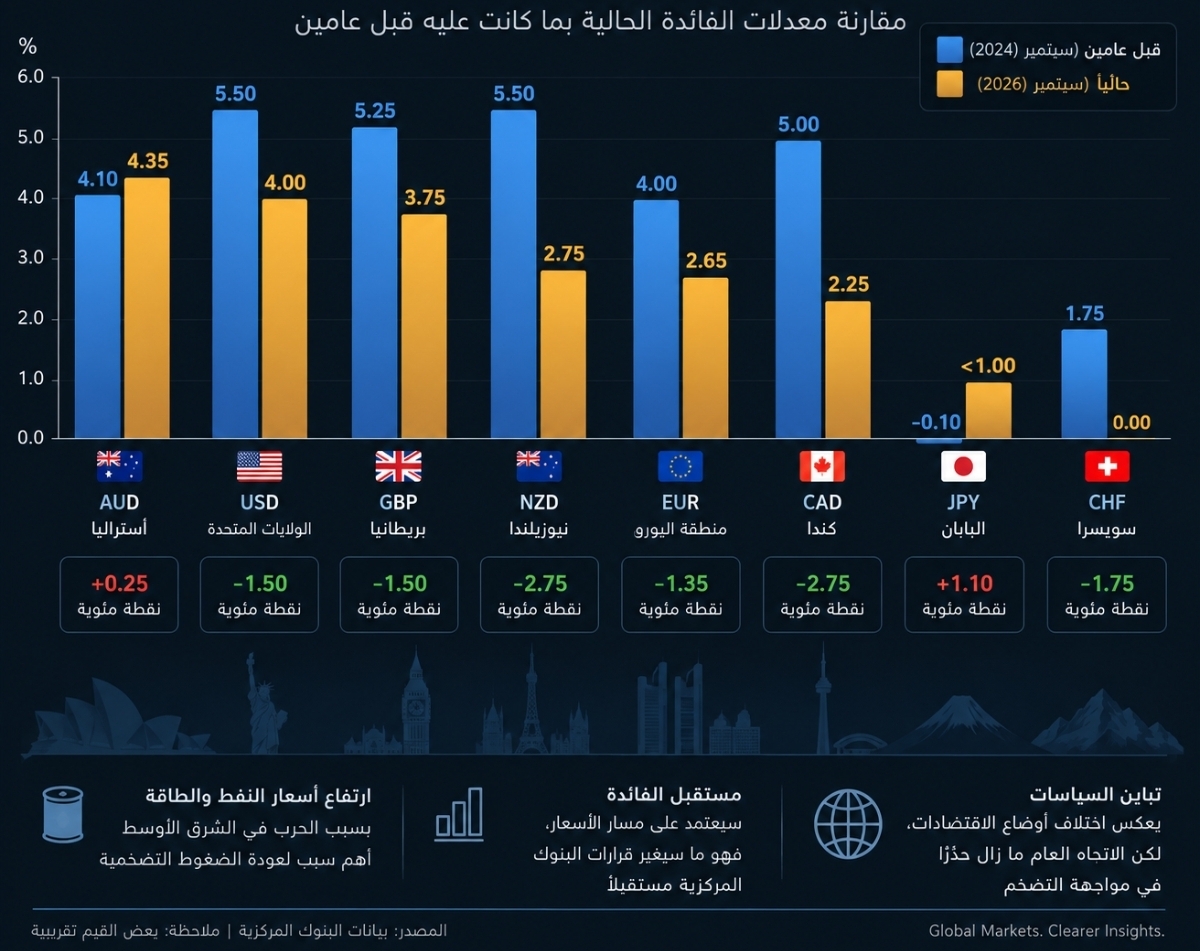
Despite the current trend toward raising interest rates to combat inflationary pressures and rising energy prices, interest rates in most major economies remain significantly lower than they were two years ago. The past period saw a broad cycle of interest rate cuts following a decline in inflation, before rising prices again reversed course. Therefore, the current increases can be seen as a partial return to monetary tightening from lower levels, and not yet a return to the high interest rates that prevailed two years ago.
Next step:
The most important driver of monetary policy in the coming period will be the trajectory of inflation, specifically the extent to which rising oil and energy prices are transmitted to other price components . The war in the Middle East and the increased costs of energy, transportation, and production have revived inflationary pressures that central banks had hoped to contain.
Therefore, the Bank of England's decision to hold rates steady today does not necessarily mean the end of tightening, just as the Federal Reserve's rate hike does not necessarily signal the start of a sustained series of increases. Price changes will ultimately determine the future course of interest rates : persistently high oil prices and inflation will reinforce the need for tighter monetary policy, while declining energy prices and easing inflation could allow central banks to pause rate hikes or eventually move towards easing.