
Stock markets on September 18, 2026, saw mixed performance between the United States and Europe. While US technology indices maintained modest gains, most European indices came under clear selling pressure, as investors continued to assess recent central bank decisions and movements in oil and bond yields.
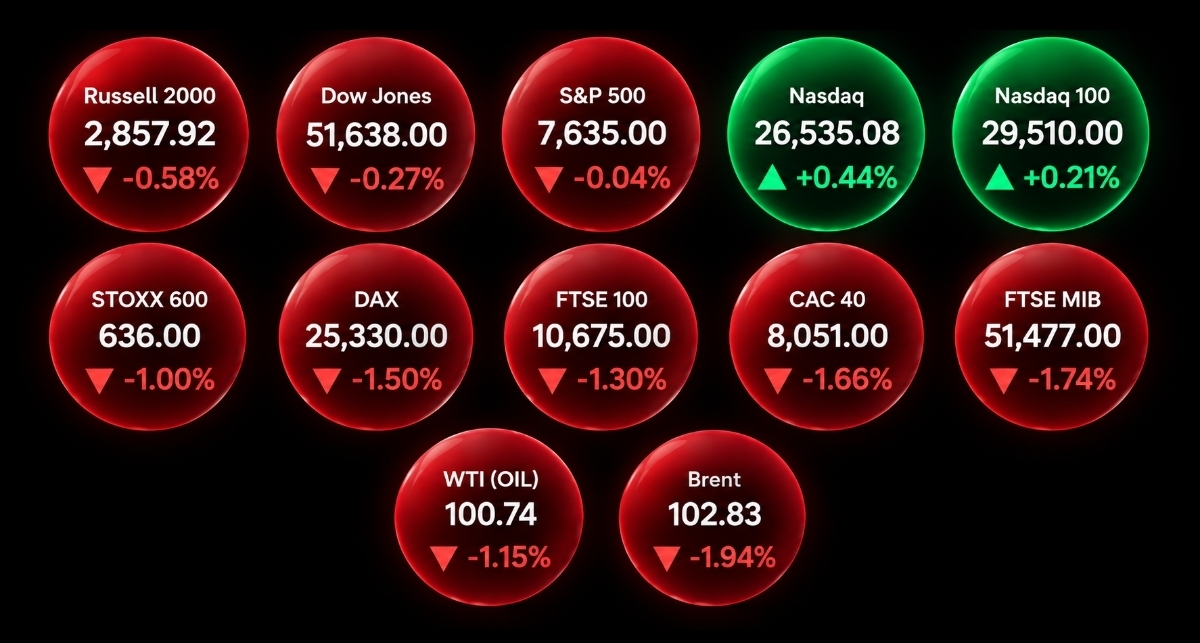
On Wall Street , the Dow Jones Industrial Average fell by about 0.27% to 51,638 points , while the S&P 500 edged down slightly by 0.04% to 7,635 points . In contrast, technology stocks performed better, with the Nasdaq Composite rising by about 0.44% to 26,535 points and the Nasdaq 100 climbing by 0.21% to 29,510 points . The Russell 2000, however, declined by about 0.58% to 2,858 points .
This performance suggests that US markets have not yet formed a unified front following the Fed's recent decisions. On the one hand, expectations of continued economic growth and a robust labor market are still supporting stocks, but on the other hand , rising bond yields and persistently high interest rates are dampening investors' appetite for risk.
US manufacturing data also came in relatively weaker, with manufacturing output declining in August, adding another factor to the cautious mood in the market.
Europe is experiencing a wider sell-off.
The pressures were more evident in the European markets. The STOXX 600 fell by about 1% to 636 points , the German DAX dropped 1.50% to 25,330 points , while the British FTSE 100 lost about 1.30% to reach 10,675 points .
France’s CAC 40 also fell by 1.66% to 8,051 points , and Italy’s FTSE MIB recorded the biggest decline among the major European indices in the report, falling by about 1.74% to 51,477 points .
This decline comes after strong gains in the previous session, opening the door for some profit-taking , as investors reassess the course of global monetary policy after a busy week of central bank decisions.
The decline in oil prices is providing some relief to markets.
On the other hand, one positive factor came from the energy market. US crude (WTI) fell to around $100.74 a barrel, down 1.15% , while Brent crude fell to around $102.83, down 1.94% .
The decline in oil prices is important for stocks at this stage, as a continued drop in energy prices could ease inflationary pressures and reduce the need for further monetary tightening. However, oil remaining above $100 means that energy-related inflation risks have not yet disappeared.
Markets remain hostage to oil and interest rates.
The current picture doesn't so much indicate a stable market trend as it reflects a period of heightened sensitivity to news . Investors are simultaneously monitoring economic growth, inflation, bond yields, oil prices, and central bank decisions.
The Middle East remains the most volatile factor . If oil prices continue to decline or stabilize, equities may have more room to recover. However, if developments revive supply concerns and drive oil prices sharply higher, inflation and interest rate hike fears could resurface.
Therefore, today's decline does not necessarily signify the start of a prolonged downward trend, just as any new rise does not mean the end of the risks . At this stage, the direction of oil prices, developments in the Middle East, and the trajectory of bond yields will remain among the most important factors determining the direction of stock markets in the coming sessions.